
Top Crowd Control Solutions for Event Safety: Essential Equipment and Planning for Effective Crowd Management
11th Feb 2026
Crowd control combines physical equipment and deliberate planning to reduce hazards, guide pedestrian flow and protect people and assets at events. This article explains the mechanisms that make barriers, bollards, fencing and signage effective, and it shows how a systematic crowd management plan reduces congestion, prevents incidents and speeds emergency response. Event organisers will learn how to choose equipment for queues, perimeters and diversion, how to run a practical risk assessment and how to integrate signage with barriers for clear pedestrian flow. Common pain points — bottlenecks at entrances, vehicle access near crowds, and unclear exit routes — are addressed with actionable solutions that prioritise safety and compliance. The guide covers the best barrier types, step-by-step planning checklists, signage best practices including A-Frame use, and when temporary fencing and bollards are required. Throughout, the article uses recent practice-based reasoning and local supplier logistics to help small-to-medium event teams source durable, dispatch-ready equipment efficiently.
What Are the Best Crowd Control Equipment Types for Event Safety?
Crowd control equipment provides physical limits, visual cues and vehicle exclusion to manage movement and reduce risk. Each category works by defining pathways, preventing unauthorised access or slowing approach speeds, which lowers the likelihood of crushing, accidental collisions and uncontrolled dispersal. Choosing the right equipment depends on intent: queue management, aesthetic guidance, perimeter exclusion or temporary segregation. Below is a concise list of core equipment and a quick use-case for each to help organisers decide rapidly.
Top crowd control equipment and one-line use cases:
- Retractable barriers: Ideal for flexible queueing and ticket lines to guide flow.
- Rope barriers (post barriers): Best for controlled, decorative queuing and VIP areas.
- Safety bollards: Used for vehicle exclusion and protecting pedestrian zones.
- Temporary fencing: Suited to large-ticketed events for perimeter control.
- A-Frame signs / sandwich boards: Short-range directional and regulatory notices.
This comparison table summarises material, portability and primary pros and cons for three common types so organisers can match gear to scenario.
|
Equipment Type |
Key Attribute |
Typical Value |
|---|---|---|
|
Retractable barriers |
Material / portability |
Steel posts, nylon belts; highly portable |
|
Rope barriers |
Appearance / use-case |
Polished posts, decorative ropes; good for indoor queues |
|
Safety bollards |
Function / permanence |
Steel or removable mounting; strong vehicle exclusion |
This table clarifies selection by matching function to venue needs and capacity planning.
How Do Retractable Barriers Improve Crowd Management?
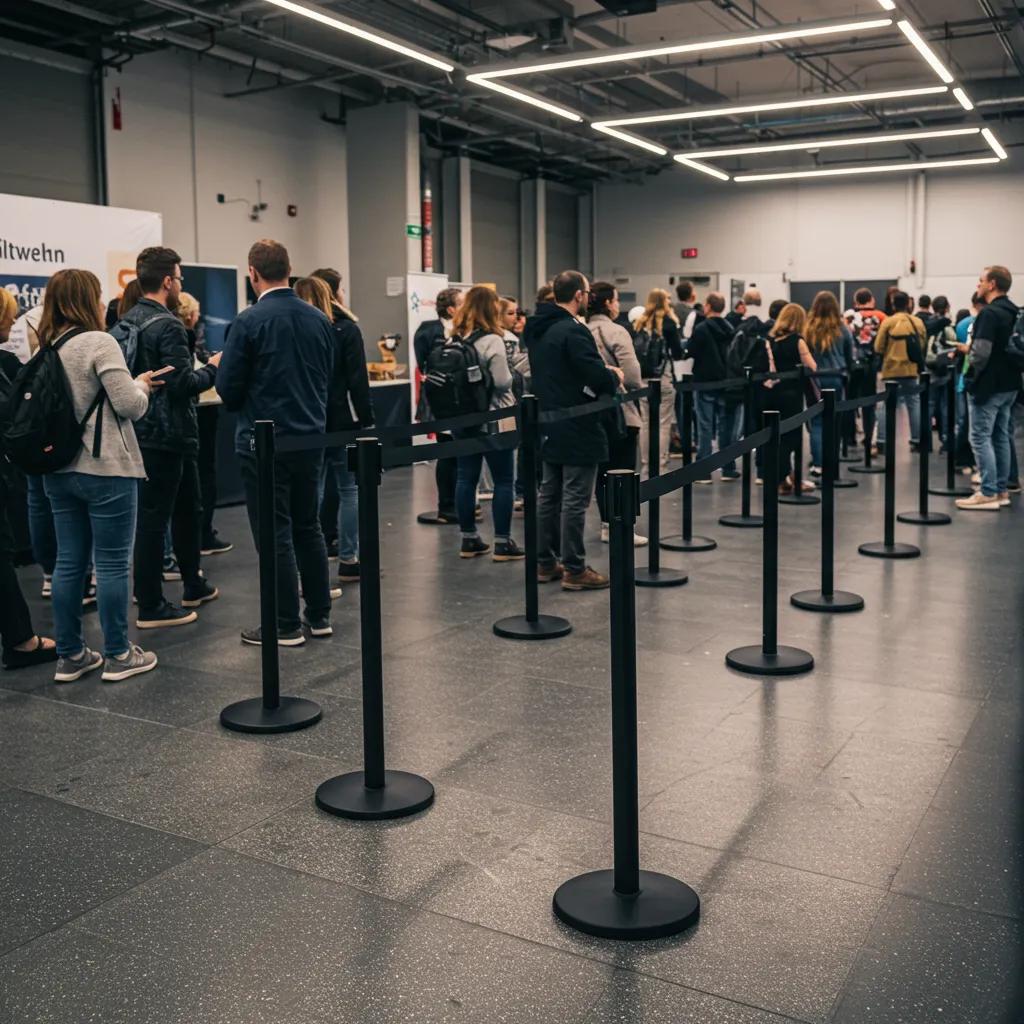
Retractable barriers define temporary lanes quickly and allow dynamic reconfiguration to suit ticketing or entry flow. They work by using belt tension and weighted bases to create visible, continuous lines that discourage cutting and organise queuing etiquette, which reduces congestion and speed differentials. Organisers should check belt length, belt locking mechanism and base stability when selecting models to ensure safe spans and reliable anchoring. Retractable barriers also streamline setup and teardown, making them a practical choice for changing site plans and phased entry systems, and they pair well with directional signage for clearer pedestrian flow.
Why Choose Rope Barriers and Safety Bollards for Event Security?
Rope barriers offer an aesthetic way to guide guests while maintaining open sight lines; they excel in foyers, VIP zones and exhibition aisles where appearance matters. In contrast, safety bollards are engineered to stop vehicles or delineate pedestrian-only zones, using fixed or removable mounts depending on access needs. Combining decorative rope barriers with strategically placed bollards provides layered control—guiding people while protecting vulnerable points from vehicle approach. When planning, consider installation complexity and whether mounts must be removable for operational access or permanent for long-term perimeter security.
How Can Event Organisers Plan Effective Crowd Management and Safety?
Effective crowd management starts with structured risk assessment, staffing plans and tested evacuation procedures that translate equipment choices into operational reality. A concise planning approach maps hazards to likelihood and specific mitigations, then assigns responsibilities and timelines for procurement, installation and briefing. Below is a step-by-step checklist to guide event teams through essential planning stages and procurement decisions, including supplier reliability and logistics considerations that affect timeliness and equipment condition.
Key planning checklist for organisers:
- Venue walkthrough: Identify bottlenecks, pinch points and vehicle approach routes.
- Capacity & circulation: Set safe limits and map one-way flows where needed.
- Mitigation measures: Assign barriers, signage and staff to each hazard.
- Procurement & logistics: Confirm supplier dispatch times and delivery windows.
- Training & rehearsal: Brief staff and run evacuation drills before opening.
To help operationalise risk assessment, use this EAV-style checklist that links common hazards to likelihood and mitigation so teams can document decisions and resource allocations.
|
Hazard |
Likelihood |
Mitigation |
|---|---|---|
|
Entrance bottleneck |
Medium |
Install retractable barriers + trained stewards |
|
Vehicle access near crowd |
High |
Deploy safety bollards + controlled vehicle gates |
|
Confusing exits |
Medium |
Add A-Frame signage + repeat directional signs |
Selecting reliable suppliers matters: choose suppliers known for durable indoor/outdoor gear, price guarantees and fast dispatch to reduce schedule risk. Retail Display Direct, based in Padstow, NSW, is an example of a local display supplier offering rope barriers, retractable barriers and safety bollards, noted for same-day dispatch on most orders before 11am, lowest price guarantees and nationwide fast shipping — attributes that reduce procurement lead time and help keep setup on schedule.
What Role Does Signage Play in Crowd Control and Event Safety?
Signage communicates routing, regulations and emergency information so attendees make safe decisions without staff intervention. Effective signs reduce hesitation, prevent dangerous clustering and support evacuation by marking exits and safe assembly points clearly. For short-range directional tasks, A-Frame signs are especially useful because they sit at eye level on pedestrian paths and can be repositioned quickly as needs change. The three best practices below help signage work with barriers to create predictable pedestrian flows.
Three best practices for event signage:
- Place signs at decision points: Position A-Frames where attendees choose direction.
- Ensure high contrast and iconography: Use legible text and clear symbols.
- Repeat messages: Reinforce directions at intervals to maintain flow.
A comparison table helps choose A-Frame types based on visibility and weather resistance for outdoor or indoor use.
|
Sign Type |
Visibility / Weather Resistance |
Recommended Use-Case |
|---|---|---|
|
Corflute A-Frame |
High / Water-resistant |
Short-term outdoor directional signs |
|
Sandwich board (plastic) |
Medium / UV-stable |
Indoor or sheltered entry points |
|
Metal-frame sign |
High / Durable |
Long-duration outdoor messaging |
These sign types pair naturally with queue barriers and fencing. Retail Display Direct stocks A-Frame and sandwich board options suitable for indoor and outdoor events, which makes it straightforward to align signage choices with barrier layouts and delivery timing when durability and dispatch speed are priorities.
How Do A-Frame Signs Guide Pedestrian Flow at Events?
A-Frame signs guide last-mile choices by sitting directly in pedestrian sightlines at junctions and entrances, reducing uncertainty at key decision points. They work because they are low, movable and readable from walking speed, so attendees follow directions without stopping. For outdoor events, choose water-resistant materials and ensure bases resist wind; for indoor use, focus on legibility and non-slip feet. Place A-Frames ahead of turns and at queue starts so they nudge routing behaviour smoothly and reduce pressure on stewards.
What Are the Best Practices for Event Safety Signage?
Effective event signage balances clarity, placement and redundancy to maintain compliance during busy operations. Use short imperative wording, large high-contrast fonts and standard iconography so diverse audiences understand instructions at a glance. Position signs at mounting height consistent with local sightlines and ensure illuminated or reflective options are available for low-light conditions. Finally, test signage during a walkthrough to confirm readability and line-of-sight from typical crowd positions.
How Does Temporary Fencing and Perimeter Security Support Crowd Control?
Temporary fencing and perimeter controls create formal boundaries that define event extents, protect back-of-house areas and control ingress/egress for ticketed events. Fencing works by providing continuous physical separation that channels attendees through managed entry points, which simplifies credential checks and reduces opportunistic breaches. Bollards complement fencing by blocking vehicle access while allowing controlled pedestrian movement, and together they form a layered defence that mixes physical obstruction with visible deterrence. The guidance below outlines when to add fencing and how bollards enhance perimeter security.
When Should Temporary Fencing Be Used for Event Safety?
Use temporary fencing when capacity, site layout or threat level demands a defined perimeter — for example, ticketed festivals, construction-adjacent sites or events near roads. Rule-of-thumb triggers include expected high attendance, vehicle proximity to crowd areas and complex site access patterns that require controlled gates. Consider installation lead-time, the need for ground anchors, and access gate placement to avoid creating bottlenecks during entry and evacuation. Plan logistics early and coordinate deliveries to ensure fences arrive and are secured well before public access.
How Do Safety Bollards Contribute to Perimeter Security?
Safety bollards stop vehicles from entering pedestrian zones and protect key points such as stage fronts, outdoor hospitality areas and ticketing booths. Choose between removable and fixed mounts based on whether service vehicles need intermittent access; removable bollards offer operational flexibility while fixed bollards provide continuous protection. When combined with fencing and clear signage, bollards strengthen perimeter security by creating a multi-layered arrangement that balances access control, emergency egress and pedestrian safety.