
Commercial Retractable Safety Barriers Explained: Essential Guide to Retractable Belt Barriers for Crowd Control and Workplace Safety
29th Dec 2025
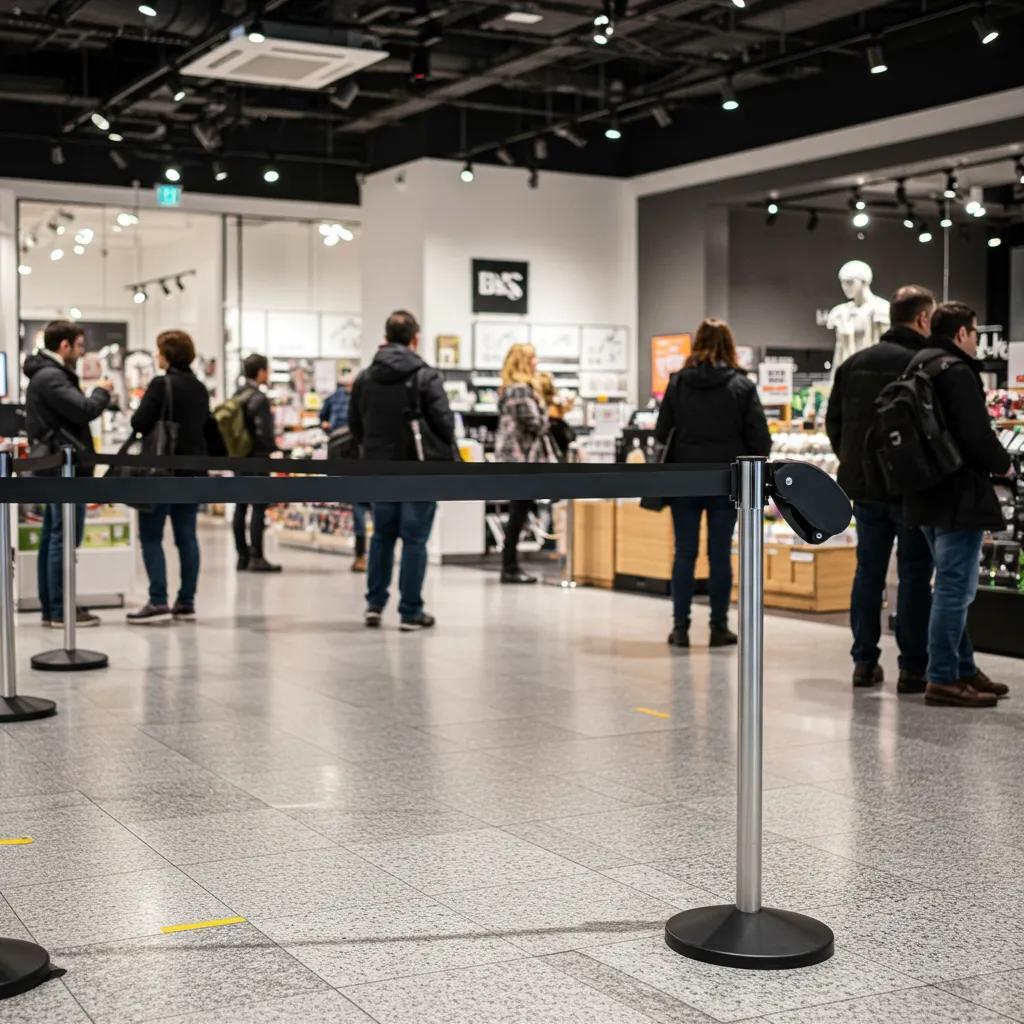
Commercial retractable safety barriers are modular crowd control and safety devices that use a retractable webbing or belt to define pathways, restrict access and protect people from hazards. They work by combining a stanchion (post), a retractable cassette mechanism and a stable base or wall bracket so the belt can extend, lock and retract smoothly, delivering controlled access and clear separation. This guide explains how these barrier systems function, compares the main types available for commercial settings, outlines measurable benefits for operations and safety, and summarises relevant UK and EU regulatory considerations. Readers will learn practical selection criteria—portability, belt length, base stability and customisation options—and simple compliance steps to ensure installations meet workplace safety expectations. The article covers component breakdowns, application-focused comparisons (retail queues, warehouses, events), benefits with operational examples, and a compliance checklist aligned to common standards. Keywords such as commercial retractable safety barrier solutions, retractable belt stanchions UK and wall mounted belt barriers warehouse are woven throughout to aid practical decision-making and procurement.
What Are Commercial Retractable Safety Barriers and How Do They Work?
Commercial retractable safety barriers are systems that create immediate, adjustable barriers using a retractable belt mechanism housed in a post or wall cassette; they work by extending the belt to a mating point where it locks and forms a continuous barrier. The mechanism relies on a spring-loaded cassette that controls tension and retract speed, producing a controlled closure that reduces snap-back risk and maintains a neat appearance. These systems deliver rapid, tool-free reconfiguration of pedestrian flow and temporary exclusion zones, making them suitable for queues, access control and short-term hazard segregation. Understanding the components that make up a barrier clarifies why choice of post material, base type and cassette features matters for specific environments.
What components make up a retractable safety barrier?
A retractable safety barrier is composed of distinct parts that determine durability, portability and compliance: the post or stanchion provides vertical support and can be steel, stainless steel or powder-coated metal for corrosion resistance. The cassette contains the retract mechanism and may include slow-retract or locking features and custom-print capability for branded belts. The base or footing supplies stability — options range from heavy weighted bases for outdoor use to low-profile wide bases for busy indoor spaces — and wall brackets enable space-saving, semi-permanent installations. Each component influences suitability: for example, a heavy-duty base is essential for outdoor crowd control, whereas a wall-mounted cassette preserves floor space in a busy warehouse, and the next section explains how these systems shape crowd flow.
- The post material affects longevity and finish in public spaces.
- The cassette design determines belt length, printability and retraction safety.
- Base type and mounting determine stability under pedestrian or environmental loads.
This component breakdown leads into how these elements translate to improved crowd control and queue management.
How do retractable belt barriers improve crowd control and queue management?
Retractable belt barriers improve crowd control by creating clear visual and physical boundaries that guide pedestrian movement, reducing confusion and preventing bottlenecks in high-traffic zones. The belts allow managers to reconp lanes quickly to match demand, which speeds throughput at checkouts, ticket lines and security points while lowering staff time spent directing traffic. In practice, a concise layout change using a few freestanding stanchions can convert a congested single queue into a managed serpentine line that increases occupancy efficiency and customer satisfaction. These operational gains make belt barriers a cost-effective alternative to fixed fencing for temporary or seasonal needs, and the next section classifies the main types available to suit different commercial use cases.
What Types of Retractable Safety Barriers Are Available for Commercial Use?
Retractable safety barriers come in several hyponymous types—freestanding retractable belt barriers, wall-mounted retractable barriers and heavy-duty/outdoor variants—each optimised for particular environments and constraints. Type choice hinges on portability, installation complexity and expected load: freestanding stanchions prioritise fast deployment and portability, wall-mounted units save floor space and suit semi-permanent segregation, while heavy-duty models deliver weatherproofing and increased base weight for outdoor crowd control. Below is a quick comparison to help match barrier type to common commercial scenarios and to inform procurement decisions.
|
Barrier Type |
Key Attribute |
Typical Use |
|---|---|---|
|
Freestanding retractable belt barrier |
Portable stanchion with weighted or wide base |
Retail queues, events, temporary lane control |
|
Wall-mounted retractable barrier |
Cassette fixed to wall or column, belt retracts to bracket |
Warehouses, loading bays, service counters |
|
Heavy-duty / outdoor retractable barrier |
Weatherproof cassette, heavy weighted base |
Outdoor events, crowd perimeters, entrances |
This table shows primary differentiators so buyers can prioritise portability, space-saving or durability when selecting barriers.
What are the features and benefits of freestanding retractable belt barriers?
Freestanding retractable belt barriers offer rapid deployment, ease of storage and flexible layout options, making them ideal for retail, hospitality and event use where arrangements change frequently. Posts are available in finishes ranging from brushed stainless steel for aesthetics to powder-coated steel for cost-effective durability, and bases may be weighted or wide to resist tipping in busy areas. Belts commonly extend 1.2–3 metres depending on model, and customisation options for printed messaging enable simple branding or directional signage. For operations needing frequent reconfiguration, freestanding stanchions reduce labour and downtime by enabling staff to alter queue flows without tools or permanent fittings, and the following section explains how wall-mounted options differ for industrial settings.
- Portable and quick to arrange for temporary queues.
- Multiple base and finish options for aesthetic or functional needs.
- Belts can be customised for branding or safety messaging.
This benefits summary connects directly to the advantages of wall-mounted choices in constrained spaces.
How do wall-mounted retractable barriers support warehouse and industrial safety?
Wall-mounted retractable barriers attach a cassette to a structural surface and extend the belt to a receiving bracket, which preserves floor area and minimises trip hazards in industrial environments. They are commonly specified to segregate pedestrian aisles from forklift routes, to provide temporary machine guards and to close off staging areas during operations; the wall-mounted form factor keeps walkways clear while allowing rapid deployment when a temporary barrier is required. High-visibility belts and heavy-duty mounts increase conspicuity and durability in harsh conditions, and regular inspection of the mount and belt tension prevents accidental disengagement. Understanding type selection completes the practical choices buyers must make; the next major section highlights the core benefits that justify adopting retractable belt systems in commercial settings.
|
Barrier Type |
Installation Complexity |
Portability |
|---|---|---|
|
Freestanding |
Low — no fixings |
High |
|
Wall-mounted |
Medium — requires bracket fixings |
Low (semi-permanent) |
|
Heavy-duty |
Medium–High — may need anchoring |
Medium |
This additional comparison clarifies trade-offs between installation effort and mobility for different barrier types.
What Are the Key Benefits of Using Retractable Belt Barriers in Commercial Settings?
Retractable belt barriers produce measurable benefits for safety, operational efficiency and brand communication by combining fast deployment with clear visual controls. They enhance workplace safety through immediate hazard segregation, reduce staff time spent managing queues and contribute to cost savings by replacing heavier permanent fencing for temporary needs. Customisable belts allow concise safety messaging or branding to reinforce instructions and corporate identity while maintaining a tidy appearance that supports customer perception. The following list summarises primary benefits and links each to practical outcomes operations teams can measure.
Retractable belt barriers deliver several core benefits:
1. Improved Safety: Quick hazard isolation reduces the risk of pedestrian collisions and access to unsafe zones.
2. Operational Efficiency: Rapid reconfiguration lowers staff time managing queues and increases throughput.
3. Cost and Storage Efficiency: Lightweight stanchions store compactly and avoid the expense of fixed installations.
4. Branding and Messaging: Printed belts communicate safety instructions and reinforce brand presence.
These benefits translate into quantifiable outcomes such as fewer obstructions, faster customer processing times and reduced need for temporary labour, and the table below links barrier features to operational value for clearer purchase justification.
|
Feature |
Operational Benefit |
Impact on Operations |
|---|---|---|
|
Slow-retract mechanism |
Reduces snap-back injuries |
Improves staff and public safety |
|
Custom-printed belts |
Communicates instructions/branding |
Reduces signage clutter and confusion |
|
Weighted base options |
Increased stability under crowd pressure |
Lowers risk of toppling and accidents |
How do retractable barriers enhance workplace safety and operational efficiency?
Retractable barriers enhance safety by providing immediate, visible separation between people and hazards, and the slow-retract cassette reduces abrupt belt snap-back that can cause injuries. By enabling quick lane adjustments, these systems reduce congestion-related incidents and improve customer flow metrics, which often translates to measurable reductions in queue times. Regular maintenance—periodic inspection of belt tension, cassette function and base integrity—sustains these benefits and minimises downtime from failed components. The next subsection explores customisation options that further increase barrier effectiveness through targeted messaging and visibility enhancements.
- Clear demarcation reduces accidental entry into hazardous zones.
- Quick deployment shortens response time to temporary hazards.
- Scheduled checks and maintenance preserve functional reliability.
This focus on safety and operational enhancements is often highlighted in industry publications.
Product Pulse: Professional Safety Insights
ABSTRACT: Anonymous. Professional Safety; Des Plaines Vol. 69, Iss. 8, (Aug 2024): 74-75.
PRODUCT PULSE
What customisation options are available for branding and messaging on retractable belts?
Customisation typically includes full-colour belt printing for logos and safety messages, a choice of belt colours for contrast and high-visibility reflective or high-contrast webbing for industrial settings. Effective messaging follows practical design rules: short, legible text at suitable font sizes, high-contrast colours and concise safety icons to ensure readability from a distance. Lead times vary by supplier and quantity, and buyers should confirm print specifications, minimum order quantities and sample proofs before committing to large runs. Well-designed branded belts serve dual purposes: they direct behaviour while strengthening visual identity, which supports both safety compliance and customer experience.
- Options include logo printing, colour selection and reflective belts.
- Design choices should prioritise legibility and contrast for safety.
- Sampling prints before bulk orders reduces production errors.
These customisation practices naturally lead into regulatory considerations that businesses must address when deploying barriers.
How Do UK and European Safety Regulations Affect Commercial Retractable Safety Barriers?
UK and EU regulations affect retractable safety barriers by defining expectations for hazard guarding, safe distances from machinery and the requirement for competent installation and maintenance; standards such as BS EN ISO 13857:2008 and the European Machinery Directive inform those expectations. Compliance means selecting products whose components and installation methods align with these standards and maintaining documentation of inspections and risk assessments to demonstrate due diligence. Businesses should evaluate whether a barrier's mechanical features—such as slow-retract cassettes and robust mountings—meet the operational risks present and implement a schedule of checks to preserve compliance. The following table maps common standards to practical compliance actions to help organisations translate policy into procurement and maintenance steps.
|
Standard / Directive |
Applies To |
Compliance Action |
|---|---|---|
|
BS EN ISO 13857:2008 |
Safeguarding distances and protective measures |
Choose barriers that maintain required distances and document risk assessments |
|
European Machinery Directive 2006/42/EC |
Machinery safety and guarding where barriers are used for machine exclusion |
Ensure barriers do not compromise machine guarding and follow installation guidance |
|
HSE guidance (general) |
Workplace traffic and pedestrian segregation |
Implement visible signage, inspection records and training for staff |
This table converts abstract standards into concrete actions procurement and safety teams can implement to reduce liability and enhance on-site safety.
What are the main UK and EU standards for retractable safety barriers?
Key standards include BS EN ISO 13857:2008, which addresses protective distances to prevent access to hazardous machine zones, and the Machinery Directive framework that sets essential health and safety requirements for machinery and guarding measures where barriers interact with equipment. National guidance from authorities such as the HSE (Health and Safety Executive) interprets how barriers contribute to pedestrian segregation and traffic management in workplaces. Buyers should treat these references as starting points for a site-specific risk assessment that determines whether a given barrier type and installation method are appropriate for the identified hazards.
- BS EN ISO 13857:2008 focuses on safeguarding distances for protective measures.
- Machinery Directive relates to the broader safety obligations for machinery and guarding.
- HSE guidance offers practical interpretation for workplace segregation.
These standard references lead directly to actionable steps businesses can take to ensure compliance.
How can businesses ensure their retractable barriers meet safety compliance?
Businesses can ensure compliance by conducting pre-purchase checks (confirming product specifications and documented conformity to relevant standards), arranging competent installation with recorded sign-off and scheduling regular inspections with retained records. A simple compliance checklist includes verifying cassette slow-retract features where necessary, confirming base stability for expected crowd loads, documenting any custom printed safety messaging for legibility and storing inspection logs to demonstrate due diligence. Training staff on correct deployment and routine visual checks after incidents or heavy use completes a pragmatic compliance programme that reduces risk. For organisations sourcing barriers, working with suppliers that emphasise durability, customisation and reliable dispatch helps execute an effective rollout.
- Pre-purchase: check specifications and conformity statements.
- Installation: use competent installers and sign-off records.
- Maintenance: schedule inspections and keep documentation.
Retail Display Direct, a supplier specialising in rope barriers and retractable barriers, supports commercial selection by offering durable, customisable and portable options suited to retail, events and industrial settings. Their offering emphasises practical procurement benefits such as same-day dispatch on many orders placed before 11am and a lowest price guarantee, which can shorten lead times for urgent deployments. Retail Display Direct is located at 3 Wordie Place, Padstow NSW 2211 Australia and can be a source for businesses seeking rapid fulfilment of standard stanchions, wall-mounted cassettes and printed belts that meet the operational criteria outlined above.
1. Verify product features before purchase: Confirm belt length, slow-retract and print capability.
2. Document installation and inspections: Keep records to demonstrate ongoing compliance.
3. Train staff for deployment and basic checks: Ensure consistent safe use and rapid response to wear.
These final actions complete the practical roadmap from selecting the right barrier type to maintaining safe, compliant installations in commercial environments.